

For about three months last fall, I finished every workday with the same routine: close my laptop, take two ibuprofen, drink a glass of water, lie on the couch for twenty minutes. I blamed it on screen time, then on dehydration, then on the fact that I stay up too late. I tried blue-light glasses. I tried setting a reminder to look away from my screen every thirty minutes. I lowered my monitor brightness until everything looked like a foggy morning. None of it stuck. None of it really helped.
My setup at the time was a 27-inch monitor on a simple desk, a cheap adjustable lamp on my left side pointing roughly toward my keyboard. It seemed fine. It lit the desk. I could see my keyboard without squinting. The problem was that the lamp sat at almost the same height as my eyes, and its light bounced straight off the lower third of my screen every afternoon when the angle of light in my office changed. By 2pm I was staring into a soft haze of reflected light and calling it a normal workday.
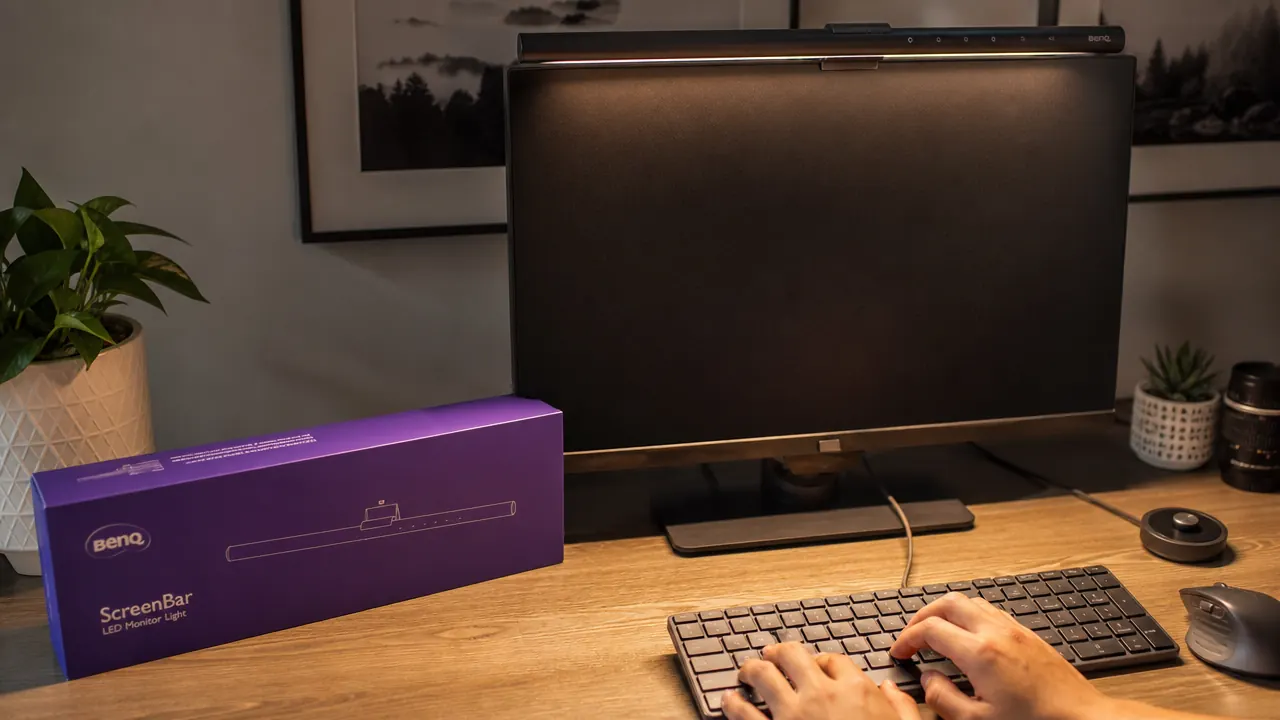
A friend who does graphic design work mentioned, almost offhand, that she had switched from a desk lamp to a monitor light bar a couple of years back and had never gone back. I had never heard of a monitor light bar. She explained it in about thirty seconds: it clips to the top of your monitor, points light straight down onto your desk and keyboard, and because of the angle and the asymmetric lens design, none of the light bounces back into your eyes or onto the screen. No glare. She was using the BenQ ScreenBar.
I looked it up that night. My first reaction was honest skepticism. Over a hundred for a light? I had a lamp. I already had a light. But I was also spending on ibuprofen every week and losing an hour of productive evening to lying on the couch recovering from something I could not name. The math shifted pretty quickly.
I had a lamp. I already had a light. But I was also losing an hour every afternoon to something I could not explain.
The ScreenBar arrived two days later. Setup took four minutes, including the time I spent reading the instructions I did not need. You clip the weighted balance arm over the top edge of your monitor, plug the USB cable into a port on the back of the monitor itself, and you are done. The bar has a touch-sensitive dial on the right side for brightness, a separate control for color temperature from a warm amber to a cooler daylight white, and an auto-dimming sensor in the middle that reads the ambient light level in the room and adjusts accordingly. That last part sounds gimmicky. It is not gimmicky. It is quietly excellent.
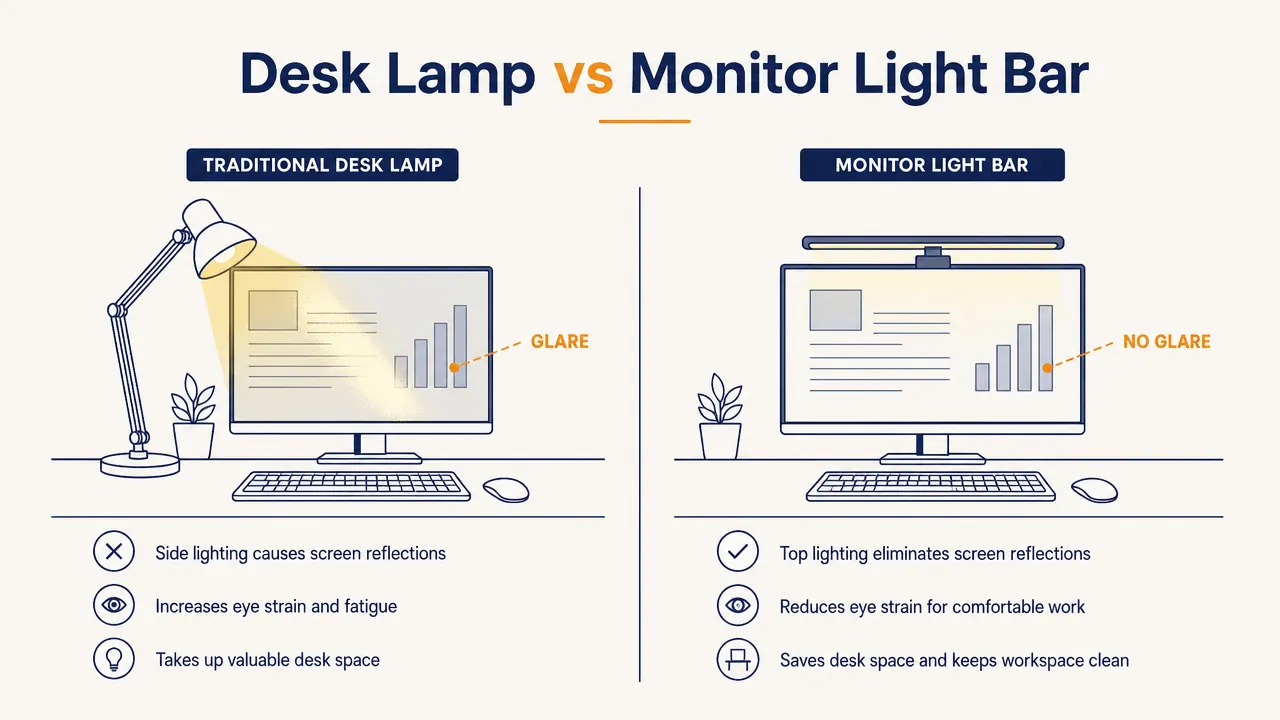
What I noticed first was not some dramatic transformation. I did not suddenly see in high definition or feel like a new person. What I noticed was that by 2pm the next day, I was still working. I was not squinting. My monitor looked like a monitor rather than a glowing fog. The keyboard was lit evenly without a bright spot on one side and darkness on the other. It was just correct. The light was correct in a way my lamp had never been.
By the end of that first week I realized I had not taken ibuprofen once. I cannot promise the ScreenBar cures headaches. What I can tell you is that mine were caused by fighting bad lighting all day without knowing that was what I was fighting. Once the lighting stopped fighting back, the headaches stopped. That is the entire story. It is boring and it is true.
There are cheaper monitor light bars. I have seen them at budget prices on Amazon. I cannot speak to those from personal experience, but I can tell you what makes the BenQ feel worth the price: the auto-dimming sensor works well enough that I have stopped thinking about my lighting entirely, which is what I wanted. I set the color temperature once to around 4000K and left it there. The sensor handles brightness as the day changes. I have not adjusted anything since the first morning. If you want to read a proper side-by-side breakdown, the comparison of the BenQ ScreenBar against a cheaper option covers it in real detail.
Still squinting at your screen by 2pm? Your lamp is probably the problem.
The BenQ ScreenBar clips to your monitor in under five minutes and puts light exactly where it needs to go, with no glare on screen and no hot spots on your keyboard. If afternoon eye strain is part of your daily routine, this is the most direct fix I know.
Amazon Check Today's Price on Amazon →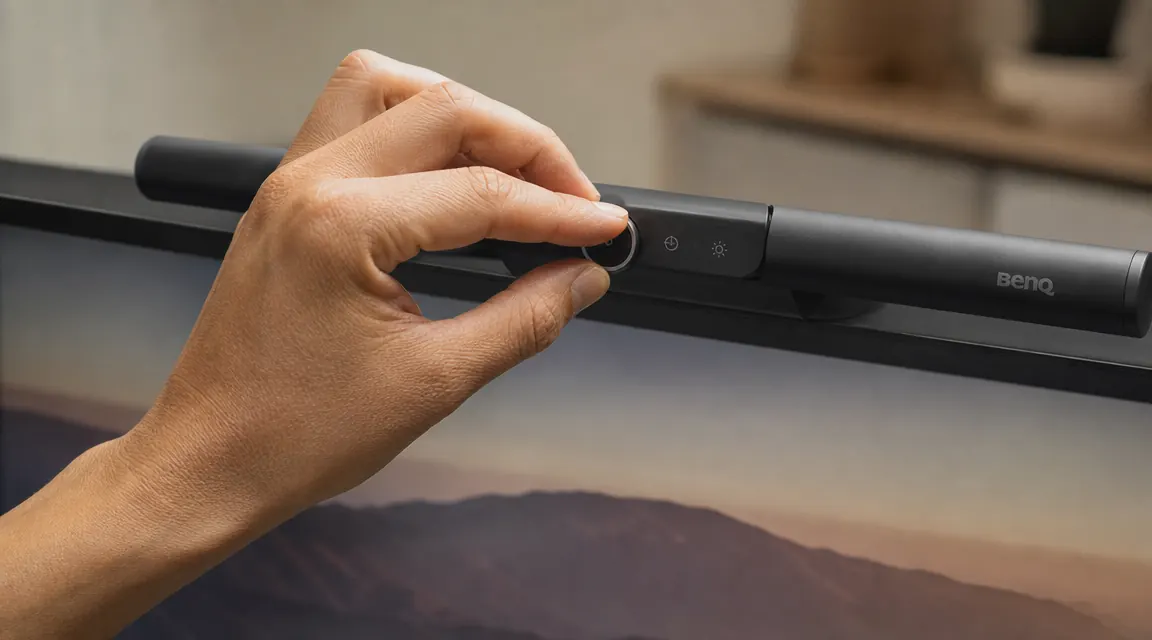
The one honest caveat: the ScreenBar requires a USB-A port on your monitor to power it. Most monitors from the past five or six years have one. If yours does not, you can use a USB wall adapter instead. Worth checking before you order. I also want to say that it only works on monitors with a flat or slightly backward-slanted top edge. Curved monitors can sometimes be tricky depending on the curve radius. BenQ does make a separate model designed for curved screens if that applies to you.
If you are interested in the full ergonomic picture of reducing eye strain during long work sessions, the guide on using a monitor light bar to reduce eye strain in a home office walks through monitor height, ambient light balance, and screen settings that work together with the light bar. Getting one piece right without the others still helps, but getting all of them right is noticeably better. There is also a longer look at why monitor light bars beat traditional desk lamps on every metric that actually matters for desk work.
What I'd Tell You If We Were Sitting at My Kitchen Table
If you are getting regular headaches after long desk sessions, or you find yourself squinting or leaning toward your screen in the afternoon, do not reach for another pair of blue-light glasses. Look at where your light is coming from and where it is landing. Most desk lamps are positioned out of habit, not out of any thought about what the monitor needs. A lamp off to one side will almost always create some glare on your screen. You learn to work around it and you never realize that working around it is costing you something. The BenQ ScreenBar review I read before buying this goes deep on two years of daily use if you want the long version. But the short version is this: it works, it stays out of your way, and the afternoon ibuprofen habit I had built up over three months disappeared inside a week. That is the honest story. I do not have a more dramatic one to give you.
If you're done troubleshooting your afternoon headaches, this is the fix.
The BenQ ScreenBar has 4.7 stars across more than 5,000 reviews. No glare on screen, auto-dimming that actually works, and setup that takes four minutes. Sometimes the simplest change is the right one.
Amazon Check Today's Price on Amazon →